
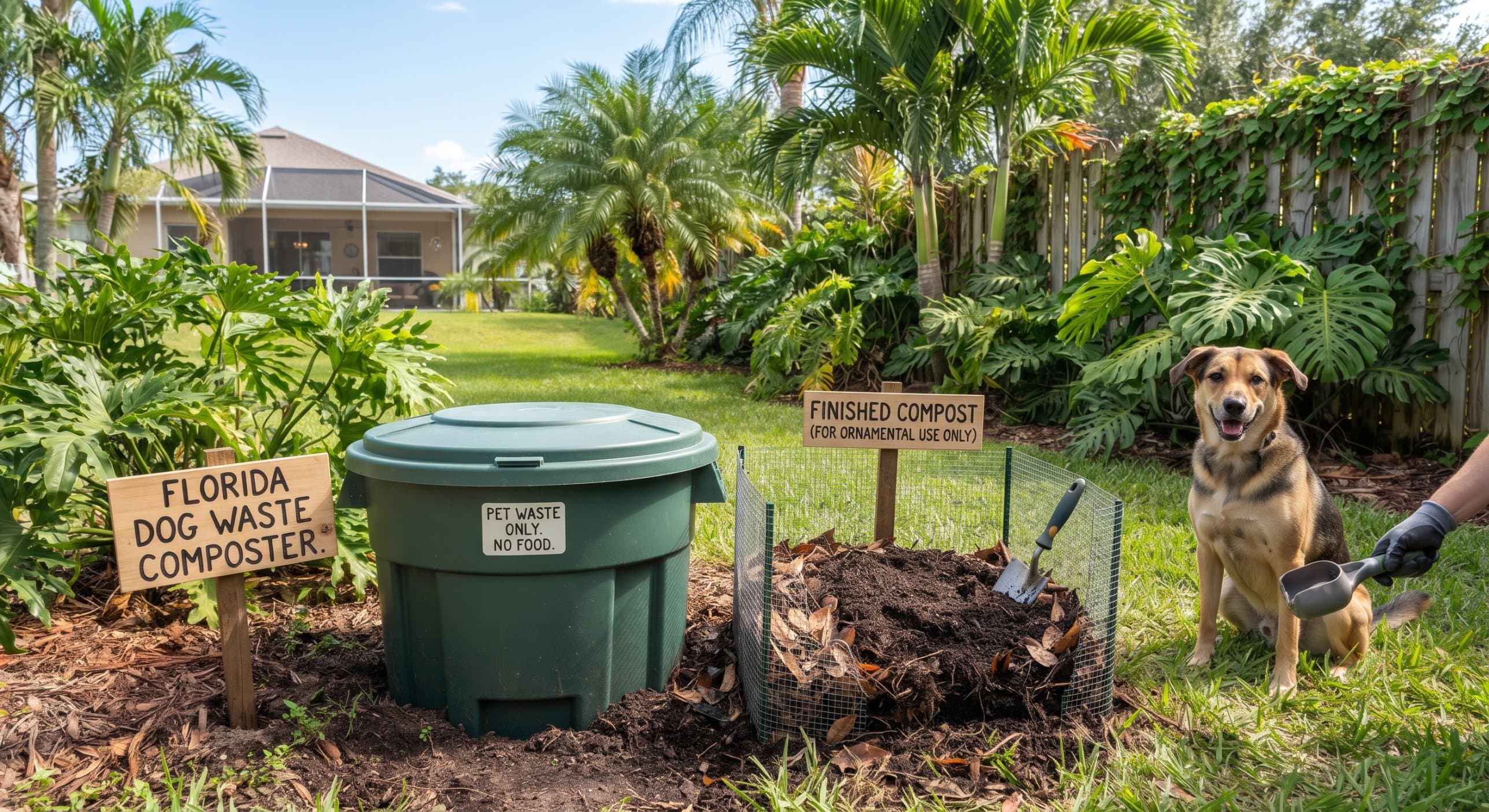
You're trying to do the right thing. You compost your vegetable scraps, you'd rather not send 274 pounds of waste a year to a landfill in a plastic bag, and somewhere online you read that dog poop can be composted.
Here's the honest answer: yes, it can be, and there's a real USDA method for it. But the requirements are far stricter than most articles admit, and for the average Florida backyard the math usually doesn't work.
The Short Answer
You can compost dog waste if, and only if, you can hit and hold the temperatures that kill pathogens, and you only use the finished product on ornamental areas.
- The pile must reach 145°F for several days to destroy pathogens
- It needs roughly 6 to 8 weeks of active composting, with several turnings
- It then needs to cure for at least another month, preferably longer
- The finished compost must never go on anything you eat
Those numbers come from the USDA's own fact sheet on composting dog waste, hosted by the EPA. It is the most authoritative guidance available, and it's worth reading before you start.
The Recipe, If You're Determined
The USDA method is specific:
- Mix about 2 shovels of dog waste to 1 shovel of sawdust or another carbon source
- Keep the pile 2 to 3 feet deep and covered
- Keep it moist, about as damp as a wrung-out sponge
- Turn it regularly over six weeks or more
- If it climbs past 160°F, split the pile, add water and turn it
- Cure the finished compost for at least a month, ideally longer
One detail that stops most homeowners cold: the USDA notes a pile really needs the waste of around 10 dogs, ideally 20, to generate and hold enough heat. A single backyard dog usually cannot feed a pile hot enough to be safe.
What You Can and Cannot Use It On
This part is not negotiable. Finished dog-waste compost can be used as a soil additive for lawn establishment, revegetation and ornamental planting beds, blended at roughly 25% for flower beds.
It must never be used on crops grown for human consumption. No vegetable garden, no herb bed, no fruit trees. It also isn't suitable for germinating seedlings, because it tends to be high in salinity.
The Health Risks Nobody Puts in the Headline
Roundworm eggs are the primary concern. They're invisible to the naked eye, they're tough, and children are at greater risk than adults.
The USDA guidance is blunt about the precautions: don't compost waste from a sick dog, keep puppies and pregnant dogs away from the compost area, don't let children play where the compost was recently applied, wear gloves, and wash your hands afterward.
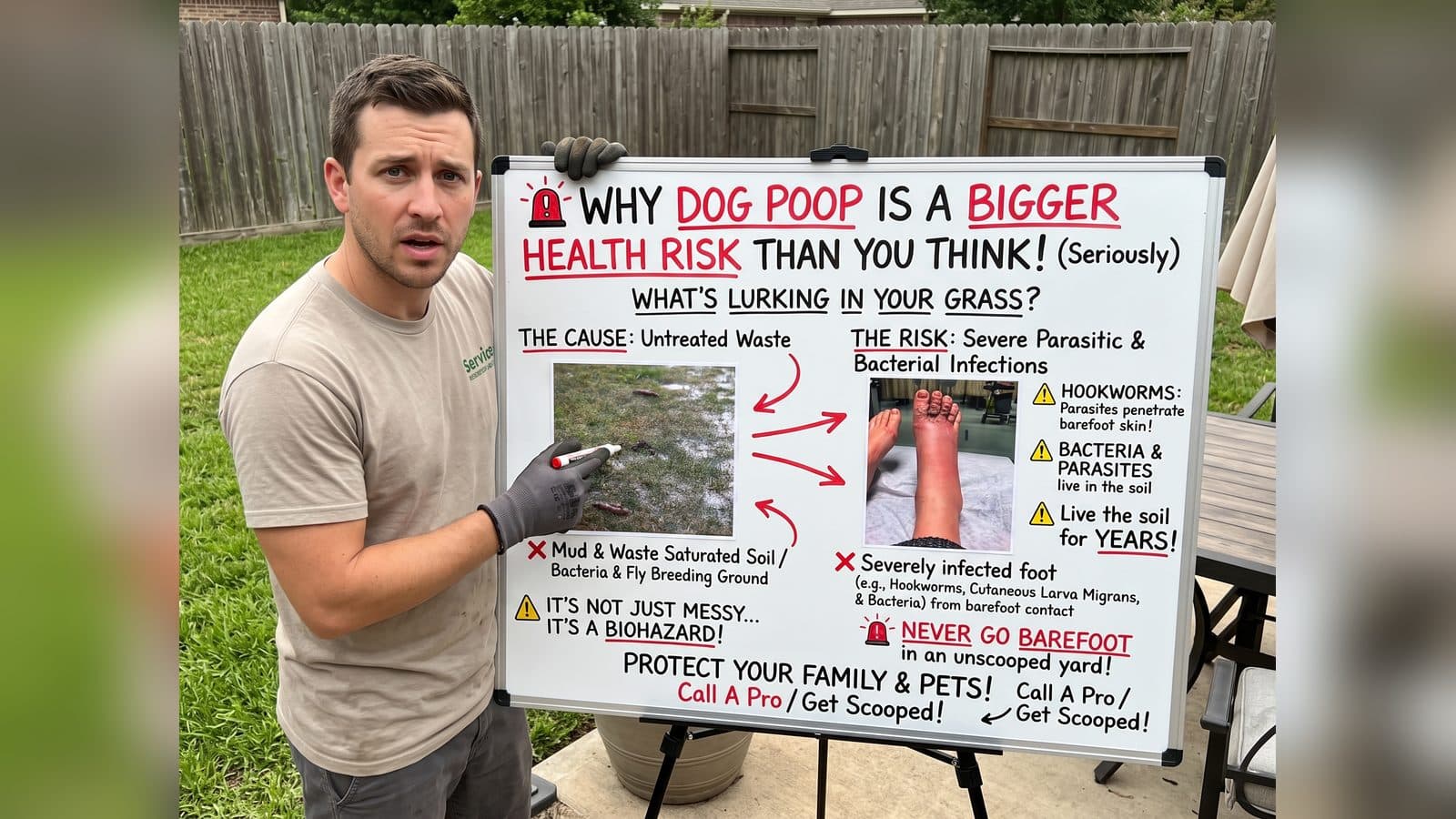
If parasites are new territory for you, why dog poop is a bigger health risk than you think covers what's actually in there.
Why Florida Makes This Harder
Our climate works against a backyard pile in three specific ways.
- Humidity and afternoon storms keep piles too wet, and soggy piles go anaerobic instead of hot
- Sandy Pasco County soil drains fast, so leaching from an uncovered pile reaches groundwater more easily
- Our heat and year-round insect activity mean an improperly managed pile becomes a fly and rodent attraction quickly
That last one matters more than people expect. If a pile draws rodents, you've traded one problem for a worse one. See does dog poop attract rats.
What To Do Instead
For almost every household with one to three dogs, bagging and binning is the safer and more practical choice, and it's what we recommend to our own customers.
If your motivation is reducing plastic, the better lever is bag choice and consistency rather than composting. The full breakdown of safe options is in how to dispose of dog poop properly.
And whatever method you choose, frequency does more for your yard than any disposal method. How often you should scoop is the single biggest factor.
Or Skip the Whole Project
Honestly? Most people who ask about composting really just want the waste gone without feeling wasteful. We can handle that part. We scoop and haul away everything, so nothing sits in your yard or your bin.
We're veteran-owned and local, serving Wesley Chapel, Zephyrhills, Land O' Lakes, San Antonio, Dade City, Lutz, New Tampa and Plant City with flat weekly pricing and no contracts.
Get your free instant quote in about 60 seconds, with no phone call needed.
Keep reading: How To Dispose of Dog Poop Properly.
Frequently Asked Questions
Can you compost dog poop at home?
It is possible but difficult. The pile must reach 145°F for several days to kill pathogens, needs 6 to 8 weeks of active composting plus a month or more of curing, and generally needs the waste of around 10 dogs to stay hot enough.
Can you use dog poop compost on a vegetable garden?
No. Finished dog-waste compost must never be used on crops grown for human consumption. It is only appropriate for lawns, revegetation and ornamental planting beds.
Why can't you compost dog poop like cow manure?
Dog waste comes from a meat eater, so it is denser and more acidic, and it carries parasites like roundworm that need sustained high heat to destroy.
Can you put dog poop in a regular backyard compost bin?
No. Ordinary backyard bins rarely reach or hold 145°F, so pathogens survive and the finished compost is unsafe to handle or spread.
What is the safest way to get rid of dog poop?
For most households, bagging it and putting it in the trash is the safest and most practical option, as long as it is picked up once or twice a week.
About the Author
Tiffani, Owner of Scoop Dog
U.S. Army veteran and Zephyrhills dog mom to Luna and Snickers. Tiffani personally scoops yards and walks dogs across Wesley Chapel, Zephyrhills, Land O' Lakes, San Antonio, Dade City, Lutz, New Tampa and Plant City, and writes every guide from what she sees in local backyards each week. Read her story.
Ready To Hand This Off?
Serving Wesley Chapel, Zephyrhills, Land O' Lakes, San Antonio, Dade City, Lutz, New Tampa & Plant City. Get your instant price in 30 seconds or call (813) 563-2310.
Local service areas
- Pooper scooper in Wesley Chapel
- Pooper scooper in Zephyrhills
- Pooper scooper in Dade City
- Pooper scooper in Lutz
- Pooper scooper in New Tampa
- Pooper scooper in Plant City
- Pooper scooper in Land O' Lakes
- Pooper scooper in San Antonio
- Dog walker in Wesley Chapel
- Dog walker in Zephyrhills
- Dog walker in Dade City
- Dog walker in Lutz
- Dog walker in New Tampa
- Dog walker in Plant City
- Dog walker in Land O' Lakes
- Dog walker in San Antonio